Category Archives: Articles

My Antiques Roadshow Adventure

By Mark Warby

“Try not to move – we don’t want to have to nail your feet to the ground,” I was told, one day last summer. This wasn’t a threat of imminent torture, though – merely a joke to help put me at ease, when I found myself in front of the TV cameras at a recording of the BBC Antiques Roadshow.

I had been to a couple of Roadshow recordings before, but only as a spectator.

Then, early last year, I saw that the BBC’s flagship Antiques show was coming to Compton Verney Art Gallery in Warwickshire on July 2, to film for their new series.

“Share a story about your special items,” it said on the show’s website – so I contacted them about my Bruce Bairnsfather collection.

Coincidentally, before WWI, Bairnsfather had known Lord Willoughby de Broke (Compton Verney’s then owner) and other members of the Verney family well and was a frequent visitor to the house.

One item in my collection has a direct connection to the Verney family, and as the Roadshow always seem to like pieces linked to their venues, I thought this might engage their interest.

I heard nothing for some weeks, but a few days before their visit to Compton Verney a researcher called me to talk about my collection. He asked me to take a few items along on the day and said I could potentially be filmed. I was even emailed an Appointment Card so that I wouldn’t have to queue.

MarK Warby Antiques Roadshow3

I arrived at Compton Verney at 9.30am, as arranged, and no sooner had I waved my pass in front of one of the stewards than I was shown to the ‘appointments waiting area’ and introduced to Clive Farahar, the Roadshow’s Books and Manuscripts expert, who chatted to me to get some background, while looking through the items I had taken along to select three or four for filming.

It was an almost brutal process. Clive would get just a glimpse of one of my prized original drawings or another treasured item as I started to show him, and immediately say “no, we don’t want that” or “no, that’s no good”, eliminating most of the things I had with me in a flash.

But the minute I pulled out a framed original 1917 theatre poster by Bairnsfather, Clive’s eyes lit up and he whisked it away to show to one of the production team.

A couple of minutes later the same happened when I showed him a 16” tall Old Bill doll. He asked what else I had, and straightaway an original published Fragment from France cartoon from 1915, and an album containing a number of original sketches by Bairnsfather, sent home from the front in 1914 to Clare Verney, cousin of Lord Willoughby de Broke, were added to Clive’s selection.

I was then taken to the “green room” where the items I had taken along were left in a secure area, and a member of the production team talked me through how things worked with the filming process.

I completed the necessary paperwork and they gave me a timeslot for filming, which was around midday. This was still a couple of hours off, so I was free to go and enjoy soaking up the atmosphere of the Roadshow and do a bit of “expert-spotting” – as well as catching a very fleeting glimpse of Fiona Bruce.

Mrs Warby and her mum had come along with me, and while we were looking around and taking everything in, they spotted two empty deckchairs branded up with the Antiques Roadshow logo and decided to take a few minutes’ rest.

They had barely sat down when a lady from the BBC came over and asked if we’d mind if she took some photos of Mrs W and her mum in the deckchairs (from behind, so the AR logo was visible). We agreed, thinking she was maybe taking pictures to post online (more on that, later).

At the allotted time we made our way back to the “Green Room”. While we were sat waiting, we noticed Clive Farahar come in, chatting to fellow Roadshow expert Hilary Kay. They headed straight for the secure area, where Clive proceeded to take out my Old Bill doll and show him to Hilary, evidently to ask her opinion on him.

A few minutes later we saw Hilary again, when she came in to see the make-up girls. Not long after this it was my turn, and I went through the surreal experience of being “made up” – and in the very same chair which Hilary Kay had just been sat!

Mar Warby Antiques roadshow Make Up

The items I had taken along were now collected and whisked away to where I was to be filmed.

As I was escorted to the ‘set’ I was asked if I had ever been on TV before. I recounted the tale of having been on BBC Midlands Today back in December 1964 with my mother and brothers when we were just three days old, due to being triplets born on Christmas Eve.

I decided not to mention my much more recent, if fleeting, appearances on Central News, Midlands Today and BBC Breakfast, as well as BBC local radio.

The spot where I was to face the cameras was being used for filming throughout the day, and a good-sized crowd had already gathered to watch. While I was being “miked up” (in the privacy of an Antiques Roadshow ‘gazebo’ – all very glamorous!) the ‘set’ was staged, with my framed drawing and poster on easels, the Old Bill doll ‘perched’ alongside the poster and the album of sketches on a tall table in front of them.

The floor manager explained what was involved in the filming, before having a final word with me and Clive Farahar about the order they wanted things to run in. Then it was “lights, camera – action!”

Mar Warby Antiques Roadshow 2

It all went by in a bit of a blur. We had to do a few re-takes where the Director wasn’t quite happy with something, and at one point the floor manager made the comment mentioned at the start of this article, about nailing my feet to the ground!

Then it was all over; Clive Farahar thanked me, and said he thought the piece we had filmed would make a good segment for the programme.

I retrieved all my items and went off to let the whole experience sink in. As I was mulling it all over, a couple sat nearby turned to me and said they had just watched me being filmed and thought I did very well and looked forward to seeing it on TV. Nice to know I already have some fans!

A couple of days later I spoke to a member of the production team, who seemed quite optimistic that the piece I filmed would be in one of the two programmes they were putting together from Compton Verney.

The new series of the Antiques Roadshow started in September, and the first programme from Compton Verney aired on BBC1 on 24 October. My piece with Clive Farahar didn’t make it into that episode, but as we were watching, we did get a little surprise.

Between valuations the cameras were panning around the crowds and getting some general views of the day. Suddenly the back of the two deck chairs mentioned earlier appeared on the screen, with Mrs Warby and her mum comfortably ensconced, and in the background yours truly (from the neck down – my head evidently out of camera shot), stood talking to them!

Although I’m still not certain I’ll be in the second programme from Compton Verney, I signed all the necessary paperwork and release forms, so fingers crossed I won’t end up on the cutting room floor. I’ve read that the Antiques Roadshow returns to BBC1 in March, so hopefully I won’t have to wait too long to find out.

And the big question – how much did Clive Farahar value my items at? Well, I don’t want to spoil the surprise, so you’ll have to watch the show to find out.

A Not-Quite-How-To Guide On Not Making Money As A Cartoonist

SORRY, EDITOR SAYS NO!

By Pete Songi

Singi main cartoon

It’s 4.55am, it’s press  day on that architectural magazine title you’re employed at, but all you can think about for the last few broken hours of sleep is the gag. That speech from Theresa May, that episode of Question Time, that toon that is swirling around and around in your head like a broken record; when is it acceptable to get the iPad out?

And so begins another day in the last 30 years working in publishing as a Production Manager, when what drives you and makes you come alive is putting pen to paper! “Just face facts, Pete, you’re a cartoonist, live with it.” But am I? A quick scout around online leaves little doubt there’s a world out there of the already successful, and in many ways far more talented. Can I find a niche? And taking an abhorrent phrase from the 90s, can I ‘monetize it?’ I get that idea is not for everyone and for most it’s a hobby; for me, though, I feel it needs to be more. The journey begins.


Reality Check

 Now, to start with, I come at this world with a good working knowledge of cartoons in print and, despite a career in magazine publishing, not too much to show for that time in artistic ventures. The odd free-to-use illustration to ‘jazz up’ a text-laden article on subjects most readers would just avoid. Making leaving cards for colleagues. (You’re so talented! You should do that for a living.)

If it was down to me, and I had the funds, I would just bring back The Cartoonist newspaper from the early 90s and pay everyone handsomely for their work. How I still miss that fortnightly hit of satire. However, that’s a pipe dream, of course. The reality in this journey is finding a home for my artwork.

So where to next? I start at the top with a quick stab at procartoonists.org, which left me wounded. Despite a career being in the right place, my few attempts at work in print were not enough to warrant that particular badge. Thankfully I found one in The Jester that fits! However, despite the honour, which I actually wear, this little accolade doesn’t enhance the bank balance.

Cartoonists’ Club of Great britain badge

Social Media is another avenue. “Just get yourself out there, Pete!”

Twitter: Feed gone in seconds and how many @’s and #tags before you start to lose the will?

Linked-In: Increasingly just a job-site ocean filled with recruitment sharks.

Facebook: Do I really want to subject my actual friends to my ‘weirdness’?

Instagram: A possibility, though you have to have the artwork on your phone or an app called Droplet on your desktop. Oh, and an actual audience.

I try local and national media, and lastly Private Eye who will happily take ideas and actually respond; see the headline above from them to me for the past four months.

The Spectator, similarly, take submissions; however, they don’t acknowledge anything, at least not to me. National media is a drop in the ocean – likewise local media who have seriously constrained budgets. I’ve found that the best place to find contacts for these can be found at https://media. info/uk/newspapers


A Penny For Your Thoughts

 I arrive at the door of The Greeting Card Industry, which is vast; though a potential way of getting cash for your work. The Greeting Card Association seems to be the place to start looking, and they have links to publishers who are looking for artists at http://www. greetingcardassociation. org.uk/resources/for- artists/publishers-looking- for-artists

This is an extremely competitive area for artists, of course, but it looks like one good site to exist on, whilst giving some proceeds to charity, is Doodle Doo. Essentially, you come up with the artwork and, if your card is chosen, you get a small percentage of the proceeds. Small beer, but a start! There are others out there like Thortful.com but they have a stronger filter in terms of style and quality, if you don’t fit what they want you only appear in the ‘classifieds’ (not up the front of the site) so revenue potential is minimal.

There’s also further afield, for example, the American market, to consider, at Oatmeal Studios (if they get the British wit, of course!)

Holding on the line


Selling Your Soul

 At this point in proceedings I look into the mirror and ask, “Is it worth it, Pete?”

My somewhat-deflated reflection encourages me. “There are still options! You can still sell your cartoons and illustrations on stock photo sites like iStock and cartoonstock.com. It’s a large puddle to swim in, but what’s better then waking up to a sale?”

“You’re right!” I tell him. (I confess to not actually making it on there yet as the contact system is less than communicative, but again, worth a try?)

A final solution, and where I currently find myself, are Point of Sale sites where your artwork is put on merchandise such as greeting cards, mugs, T-shirts – you name it – and put up for sale. If somebody buys it you get a percentage. Zazzle are one of the most popular.


The Conclusion

 Ownership is a big deal to many, but if you can’t get what you want from who you want you may have to make your own luck. If that means some bloke in Holland wearing a Foxy T-shirt, then so be it!

I’m off to do a cartoon for Jester before deadline and apply again for my annual attempt at Pro Cartoonists. They’ll say yes eventually! Watch this space.

Lakes International Comic Arts Festival 2019

We’ve been heading to Kendal for the Lakes International Comics Art Festival for a few years now. Our stand, thanks to the handy hands of Rich Skipworth, has become a wall of members’ merchandise and cartoon prints. We always encourage members to attend and every year one or two new faces turn up and join in the fun. Noel Ford was due to be with us, so in some respects it was bittersweet, but he wouldn’t have wanted us to mope about – Noel was all about the laughs. And laugh we did.

Highlights included a John Stilgoe fan going giddy over his Jack Russel cartoons, greyhounds galore as Rich Skipworth’s fan-base descended for his new book and calender, two cracking evening meals, a new format AGM around a crowded table in Wetherspoons, and stumbling upon a late night speakeasy in a dark street!

Towers of Power

The Towers of Power, courtesy of Rich Skipworth


Late Sunday afternoon we all raised a Kinnie and Cointreau to Noel – one of his favourite tipples.


Simon Chadwick doodling something… Punter and daughter take in the ’toons.


Some of the many greyhound owners and dogs that came in, many of which (owners and dogs) were already wearing Skipworth merchandise.


A Rich Skipworth fan even found us at our AGM. She was lovely.

Above: Keri Johnson brought her friend. 


Tim Harries does some live drawing.


Simon Chadwick, Nikki Harries, Gill Skipworth and Anna Kane.


Chris Williams with possibly the world’s greatest dessert.


Many of us gather for a Sunday evening meal at a fabulous restaurant recommended by Will Rudling.


We’ll definitely be going back. Don’t miss out – join us in Kendal next year!

Tribute to Noel Ford

Noel wins cartoon of the week at one of the many Malta Mini-Cons. He was always equally surprised and delighted when his cartoon finished in the top three despite being the most experienced cartoonist there.


Noel’s funeral was on 16 October 2019 in Hereford. Our very own Paul Hardman oversaw the service and it couldn’t have been better. You did good, Paul.

Pete Dredge’s Eulogy

Pete Dredge was asked to deliver the eulogy, reproduced here, and, like with Paul, I’m sure Noel would have been delighted:

I can’t remember the first time I met Noel. It must’ve been well over 40 years ago, probably at a Cartoonists Club convention at Clacton on Sea in 1977. Who said cartooning was a glamorous life? But I can remember when I first came across his work. I had only recently left art college and was working as a third rate illustrator in a Leicestershire design studio.

My dad worked in the drinks industry, he was a rep for Gordons Gin, and on his travels, he was given the latest Guinness cartoon calendar for 1976 and passed it on to me knowing that I harboured a distant ambition of becoming a cartoonist. It was full of brilliant cartoons by someone called Noel Ford.

I had also been a regular reader of Punch magazine for a number of years. I say ‘reader’, I didn’t read the articles, it was the many fabulous cartoons by brilliant cartoonists that I poured over. Bill Tidy, Mike Williams, Larry, Honeysett, Albert, Ed McLachlan, Hector Breeze, Ray Lowry… I could go on. Then this Noel Ford chap’s work suddenly started to appear with alarming regularity. Gags, double-page spreads and colour covers all fabulously drawn with that distinctive NOEL FORD signature.

Noel always went on about how your clear, legible signature was the best, free advertising for your work. A simple, basic lesson I have failed to learn in over 40 years of cartooning. Suitably inspired, it wasn’t long after that that I decided to make a concerted effort to become a cartoonist myself and it was the biggest thrill of my life when Punch started to buy my work, too. I’ve been floundering in Noel’s slipstream ever since.

Noel was a modest chap, never one to blow his own trumpet (although, with his musical talent, this would probably not have been a difficult task to undertake). But he was someone who would go about his business with the supreme confidence of knowing that he was, and had been for many years, at the top of his game.

It’s pointless listing Noel’s professional credits, there are too many to mention, but one of his many gifts was his ability to rally, organise and deliver cartoonist-related projects. A professional cat herder if ever there was one.

I’ve seen Noel’s patient diplomacy, wisdom and common sense work effectively at close hand on numerous occasions when other’s egos, intransigence and misconceptions (no names) have threatened to scupper proceedings.

All it would take would be a few choice words from Noel and troubled waters would be smoothed over. Such was the respect that his fellow professionals had for him.

CCGB get-togethers often meant an excuse for getting musical instruments out. This one was taken at our Butlin’s get-together almost ten years ago. Noel’s joined by Tim Harries and Bren Romans.


The Cartoonists’ Guild, College of Cartoon Art, and most successfully The Professional Cartoonists’ Organisation, all benefited hugely from Noel’s vision, perseverance and professionalism. Without Noel’s input it’s extremely doubtful that many of these initiatives would’ve seen the light of day.

Added to this must be his invaluable committee work not only on the long-running Shrewsbury Cartoon Festival but also on the committee of the Cartoonists’ Club of Great Britain where he had been a member since 1972 and recently become chair.

Noel certainly put in much more than he took out with these extracurricular calls of duty.

Noel’s sublime organising skills also came into play with one of his other great passions in life, food. Not the preparing of but the consuming of it.

One of the cartoon festivals we used to attend in the late 1990s was up in Ayr in Scotland. We would be ferried up to Glasgow by Virgin Trains and then the local service to Ayr and then on to the Horizon Hotel.

The highlight of the event would happen on the last evening when the organiser, a lovely bloke called John Hamilton, would book out the Royal Blossom, Ayr’s finest Chinese Restaurant. Noel and one or two others (Dave Follows and Paul Hardman come to mind) had been attending this long-running festival since the first year and had sussed out that the best place to sit in this restaurant was at the revolving table (the Lazy Susan is what I believe they’re called). At this table all you had to do was wait for the many courses of mouthwatering Oriental dishes to come to you rather than fight for your share on the other more conventional dining tables.

Every year, while other less well-informed cartoonists would mill about like lost children waiting to be seated, Noel and his select band of co-conspirators (myself included) would push through the crowd and make a beeline for the best seats in the house and gorge ourselves silly over the next three hours or so.

Noel could always find humour in the most unlikely situations and I suspect that he persuaded Margaret to move to their lovely home at Hope in Dinsmore just so that he could say: “We now live in Hope.”

Given the current political climate, I didn’t know if Noel was a remainer or leaver but, given the love he had for his many canine friends over the years, I suspect he was a retriever!

I last spoke to Noel about two weeks before he passed away. I took a call from his hospital bed. He asked if I could complete a cartoon for one of his long-standing clients. He couldn’t hold a pen and didn’t want to let the editor down.

I was sitting outside a referral opthalmic veterinary practice in Sunderland at the time. Our dog had just undergone bilateral cataract surgery and Noel was more concerned about the welfare of our dog than he was about his own wellbeing.

Thanks for the memories, Noel Ford. We’ll all miss your Muttley-like chuckle. You’ll be greatly missed not only by your family and friends but also by the wider cartoonist community at home and abroad. See you anon.

Jester Editor Simon Chadwick’s tribute


Not a brilliant photo, but a fond memory all the same.It was my first CCGB event – in Milton Keynes! The plan was for everyone to dress as their favourite comic or cartoon character one evening, but for some reason the only person who managed to do it was Noel.Despite his room being a short distance away he remained in Rupert regalia for the entire evening, taking very good care of the large glasses of red wine placed in his care.

Simon Chadwick

Gilbert Wilkinson’s ‘what a war!’

By Mark Warby

Published in Issue 535 of The Jester magazine, October 2019

Eighty years ago, on 3 September 1939, England once again found itself at war with Germany. A little under six weeks later, on 13 October, the Daily Herald announced a new cartoon series by Gilbert Wilkinson, titled ‘What A War!’ They revealed details of six of the characters who would feature in the new series – “you are going to meet them, like them – and laugh at them” – and declared that Gilbert Wilkinson had never before “devised a more rollicking entertainment”.

Gilbert Wilkinson

The following day, 14 October 1939, barmaid Ruby Rumour and her ‘regular’ Panicky Perce made their debut, in the very first ‘What A War’ cartoon. Next up were Able Seamen Lovem and Leavem, who made their first appearance on 16 October, and on 17 October readers were introduced to the “fervent but depressed” German waiters, Swastik and Siegfried.

Two months later, on 18 December 1939, Gertie Gestapo (the synthetic spy), a “well-dressed young woman with immaculate blonde coiffure and swastika-shaped beauty spot on her cheek”, joined the cast. Sent to Britain by the Fuhrer to observe daily life in Britain and report valuable information back to Germany, Gertie’s reports formed the captions to the cartoons in which she featured.

Gilbert Wilkinson’s cast of characters continued to grow. Four days before Christmas 1939, Horace the Horoscope Fan, a young, “melancholy warrior” with an obsession for reading horoscopes, was added, and during 1940 the Little Nazi, a young child with “certain recognisable characteristics” who was a “product of a certain European country controlled by the National Sozialistiche Deutsche Arbeiterpartei” (more commonly known as the Nazi Party) made his debut. Then, on 11 January 1941, it was the turn of Herr Satz, a “loyal follower of the Fuhrer and member of the National Sozialistiche Deutsche Arbeiterpartei” and two days later munitions factory workers Mae and June – “one’s pretty, one’s comfortable” – were introduced to Daily Herald readers. A sensitive Bohemian artist called Paul, who was keen to ‘do his bit’ was another addition.

The ‘What A War!’ series proved so popular that, in December 1942, a compilation of 250 of Gilbert Wilkinson’s cartoons was published, priced 1 shilling. A second volume followed in June 1944.

What a War 1

On 7 May 1945 – the day before VE Day – after more than 1,700 cartoons, the Daily Herald published the last of Gilbert Wilkinson’s ‘What A War!’ drawings.

Four days later, on 11 May 1945, as the impact of peace was still sinking in across Britain, he began a new series in the Daily Herald, under the title ‘What A Life!’

Having “brought smiles to the darkest days” of the war, he now “found the funny sides of demobilisation, rationing, the National Health scheme, holidays at home, nylons, Russian footballers, whalemeat, the New Look and a hundred other post-war phenomena.”

This “golden, good humour” would continue for 20 years
– outliving the newspaper itself (when the Daily Herald ceased publication in 1964 and was relaunched as The Sun, ‘What A Life!’ transferred to the new paper).

After less than a year in its new home, however, ‘What A Life’ came to an unexpected end, with the death of its creator.

Gilbert Wilkinson died at his home in Pinner on 9 June 1965, following a heart attack. He was 73. His last cartoon, drawn while he was in hospital, was published on 11 June 1965.

Gilbert Wilkinson was born in Liverpool on 9 October 1891. He studied at Liverpool Art School for a year, then moved with his family to London and studied at the Bolt Court Art School, Fleet Street, and in the evenings at Camberwell and the City & Guilds Art School.

At 16 he was apprenticed to colour printers Nathaniel Lloyd, and by 1912 he was earning £2 a week drawing showcards.

But he had also started to submit cartoons to newspapers and magazines. He had his first drawings accepted by the Morning Leader, and later deputized for their political cartoonist, Arthur Moreland, who was a great influence on his work. Wilkinson also began contributing cartoons to other publications including the London Opinion, published by Odhams Press.

What a War 2

From 1915, Wilkinson served with the London Scottish Regiment, reaching the rank of lance-corporal. He continued to draw cartoons, his work appearing in the Passing Show in 1918.

At the end of the war he renewed his association with the London Opinion, also contributing to Punch, the London Mail and Passing Show. In 1921 he began drawing his legendary colour covers for the Passing Show, continuing until it merged with Illustrated in 1939. Wilkinson also contributed to Strand Magazine (illustrating, amongst others, Jeeves stories by PG Wodehouse and Father Brown by GK Chesterton), Good Housekeeping, Pan and John Bull.

That clip studio …. How’s that work then? … Selection Launcher

Eich Skipworth October 2019 1

RICH SKIPWORTH’S VOYAGE INTO THE UNKNOWN!

This Article appeared in Issue 36 of  The Jester magazine, October 2019

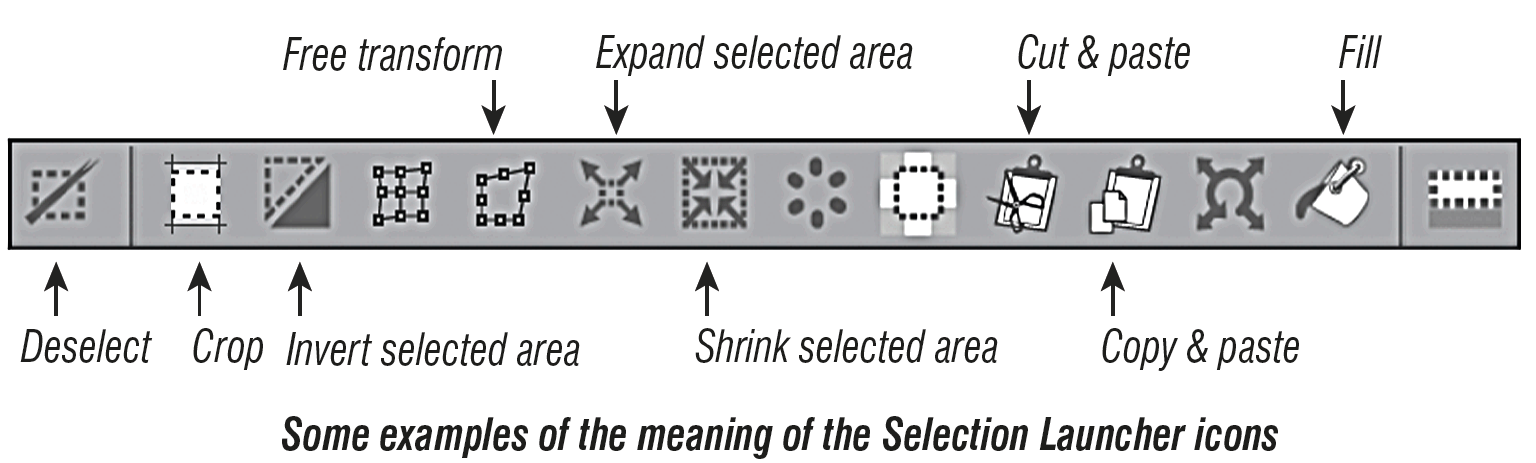
Whenever you have something selected in Clip Studio, you get this curious little row of icons appearing underneath the selection area.

This is the Selection Launcher.

If you don’t see it when you have an area selected, choose ‘Selection Launcher’ from the View menu at the top of the scree. I’ve found it to be pretty handy. It gives you quick access to all kinds of functions that can affect the selected area. Each function is represented by an icon in the palette and if you hover your cursor over an icon, a small piece of text will appear
to inform you what function the icon represents.

Like everything else in Clip Studio, the Launcher is endlessly editable.

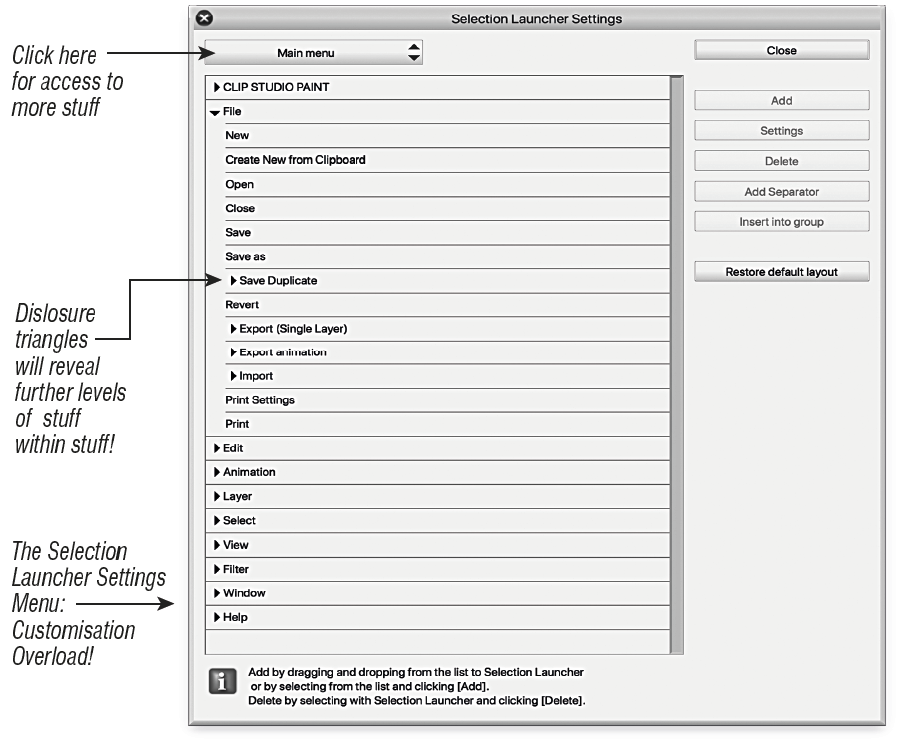
The best way to customise it is firstly make sure the Launcher is visible, then from the View menu choose Selection Launcher Settings…  This will bring up the Selection Launcher Settings menuwhich will give you access to just about all the tools and functions that Clip Studio has.

Selection Menu

To add anything from this menu to the Launcher, simply drag and drop into the Launcher, or select something in the Selection Launcher Settings list and click the ‘Add’ button. To delete something from the Launcher, click on it in the Launcher to highlight it, then press ‘Delete’ in the Launcher Settings window.

There’s also a handy ‘Restore default layout’ button.

The Selection Launcher can prove to be really convenient and useful especially if you work on a large screen, or maybe on two screens with a lot of your palettes on the second one.

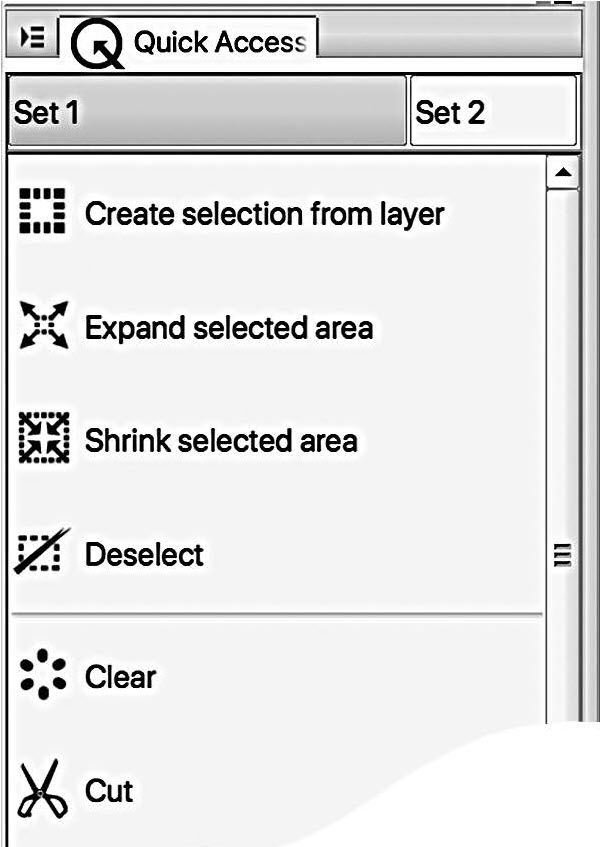
Now just to make things more confusing, there is another palette which also gives you a customisable list of tools and functions. It can contain all the same stuff as the Selection Launcher, or you can choose another set entirely. Or several sets.

This second palette that gives you quick access to functions and tools is known as the, er, Quick Access palette. It’s a permanently visible palette, ie not a floating one that appears only when a selection is active.

To see it, go to the Window menu at the top of your screen and choose Quick Access.

Customise it by choosing Quick Access settings from the bottom of the menu, or via this corner icon. A similar menu to the Launcher Settings menu appears, allowing you to drag and drop anything into the Quick Access menu.

Rich Skipworth's How to column

Actually you need to specify how the drag and drop works by choosing ‘Change order’ from the drop down menu from the corner icon. You can choose to have just ‘Drag’ or (on a Mac) ‘cmd-drag’

You can drag and drop (depending on your choice of how that works) from the Quick Access palette straight into the Selection Launcher, and also rearrange the icons in the Launcher by dragging (again depending on your settings).

Rich Skipworth October 2019 4