Category Archives: Articles

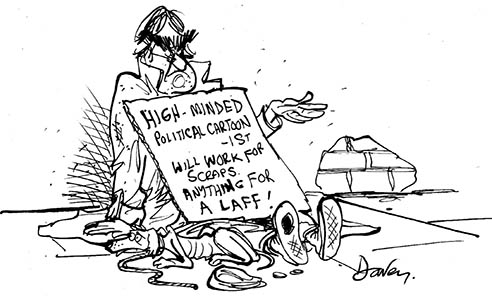
The precarious life of a political cartoonist

Andy Davey political cartoonist

This article by Andy Davey first appeared in The Jester issue 476.

Here’s a secret. Don’t tell anyone but… political cartooning is a doddle. Easy-peasy. The stories are set up for you in the news every morning. All you have to do is point out the hypocrisy inherent in most political stories with sufficient self-righteous bombast and Bob is a sure fire avuncular blood relative. You don’t even have to be funny – if you don’t believe me, check out a sample of political cartoons from major international papers over a week and see if you can raise more than one or two laughs. I mean a real coffee-spitter; not a clever, knowing chuckle. OK, some stories demand seriousness, but the best satire does need to be funny. And generally, with noble exceptions, we ain’t. Real, clever humorous talent resides elsewhere; in the best gag cartoons, in stand-up, film, writing and TV.

Andy Davey political cartoonSo, it’s easy, but why on earth would you want to do it? To have fun? To allow catharsis of your massive pent-up creative force? To set right the State of Things? All good reasons, yes, but drawing for newspapers controlled – through editorial policy – largely by vested big business interests will likely result in frustration.

Well, OK, money then. You might say that editorial cartooning for newspapers is one of the very few paths to financial comfort open to us cartoonists, rivalled only perhaps by successful strip syndication and writing the killer Christmas cartoon book. You’d be right. The problem is that in the UK there are perhaps only half a dozen full-time jobs remaining for editorial cartoonists.

Newspaper print circulation has withered. And advertising revenue has gone with it. There is no longer the money to pay journalists, let alone cartoonists. A few years ago a fellow cartoonist observed that newspaper editorial cartoonists were dinosaurs; Jurassic monsters destined for the evolutionary waste bin in short order. He was right. I personally – a minor species lost to science – have since died out. Other weightier and more impressive beasts survive and even flourish, but their habitat shrinks by the week.

Andy Davey political cartoonMartin Rowson, flourishing dinosaur and Sage of Blackheath, has a more optimistic metaphor for us. We are parasites; altogether more successful players in the Darwinian game. Upon losing our hosts (Georgian coffee houses, Victorian periodicals and now print newspapers), we simply jump off and find new blood supplies. The new sanguine host must surely be the internet. Its lack of editorial control is intoxicating, finally giving us the freedom we crave.  And it provides all manner of diversions and publication platforms to prevent us dwelling on the lack of money available to creators in this new medium. Twitter and Facebook and their other little friends welcome all creators to their digital embrace. “Go!” they seem to say. “Create! Draw! Write!” And we can now all be stars in our own lives as we whistle ever-quicker around this entropic digi-verse and up our own McLuhan-esque fundament.

But how do we make a living? Yes, I know that sounds rather vulgar to you, dear reader committed artiste that you are, but one does have to keep oneself in Absinthe, n’est-ce pas? Well, I’m afraid I don’t know. We could take solace in the thought that we are merely a subset of the larger group of creators in general. The tsunami of the internet has washed us all into the same flood basin as people who previously would have been hobbyists or part-timers. That’s not to denigrate artists or writers (ooh, Kafka, Lowry, Eliot etc.) who relied on second jobs. But maybe we will all need “portfolio careers” in future.

So, given that we can all become political cartoonists now, what should we draw? More of the same tired old daily Washington beltway and Westminster village tittle-tattle concentrating on today’s policy gaffe? Yes, by all means – it’s tremendous fun. But I’d like to suggest we look a little deeper. In a recent review of two books on the news industry in the New Statesman Peter Wilby suggested that the “cacophony of information that surrounds us” on digital media might afford us the opportunity of recreating a more reflective secondary journalism something like the Victorian pamphlet which gave an overview of a particular topic rather than responding to every twitch of a PR man’s i-phone. As Alain de Botton puts it, news “is woefully short on… coordination, distillation and curation”. Maybe cartoons can help there. That’s exactly what a good political cartoon does.

And if we’re looking deeper, why not look wider too? What is the point of satire, after all? To show up where power lies, how it is being abused and by whom. And if you can squeeze in a few fart gags on the way, so much the better. But where does power lie these days? The power of Westminster has withered. Maybe it’s moved to Brussels. I’d add to that a few more places; the privately controlled media, global mega-business, international finance, lobby groups.  All of these are unaccountable. Prime targets, surely? Yes, but very difficult to satirise because their major players are mostly hidden from our media. Hitting these targets would surely be worthwhile…but it would mean that political cartooning would no longer be easy. Oh, well, back to the Westminster tittle-tattle then. But don’t expect to be paid for it.

Andy Davey cartoon

Andy Davey
http://www.andydavey.com/
 

How Do You Do That Then? – Vanishing Point

How do you do that then?

RICH SKIPWORTH’S TIPS, TRICKS, AND NERDY TECHNO-BABBLE

This article first appeared in The Jester issue 466.

I am a Cartoonist these days. But before I was a cartoonist I was a Graphic Designer, and before that I was a Frozen Mackerel Packer. I am often called upon to combine the first and second of these skills when I produce work for various giftware companies. (No call yet for freelance cartoon mackerel packing graphics though…ah well.) Part of my giftware design job involves producing posh visuals to clients to persuade them to part with money. There’s a handy Photoshop filter that makes the design of packaging and products much easier. It’s the little known Vanishing Point Filter, and it’s dead good.

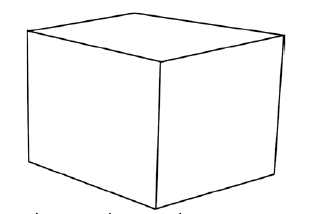
The Vanishing Point Filter in Photoshop is a means of applying graphics to your illustrations in perspec-tive interacively. It’s handy for applying lettering or logos to angled surfaces in a convincing way. Suppose you want to apply some logo or image to a simple shape. First, draw your simple shape:

figure.1


Next, draw your logo or whatever you want to apply to your shape:

figure.2

Next, select and copy that logo. Then deselect it.Then, the interesting bit….from the Filter menu at the top of your screen choose Vanishing Point.

Your screen changes, and you are presented with a new window with a spartan set of tools at the top left. Your simple shape is visible. You have now entered the mysterious Vanishing Point mode.

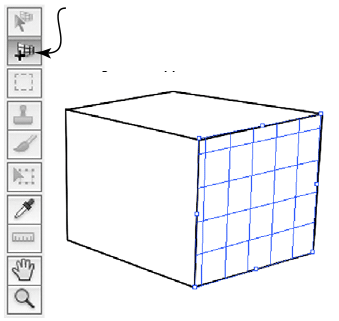
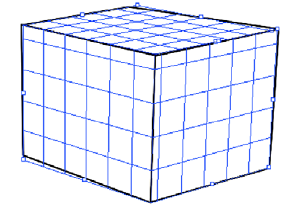
Select this tool from the palette and then click one corner at a time on a face of your simple shape. After three clicks, a blue grid will appear:

figure.3

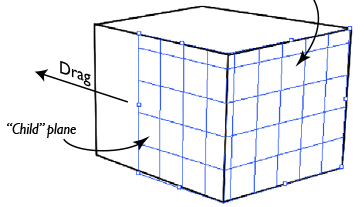
Now position your cursor over a mid point marker of the grid and hold down the Cmd key on a Mac or the Ctrl key on a PC. The cursor will change to an arrow with a small grid next to it. Click and drag.Magically, the grid is extended perpendicular to the original (or “parent”) plane.

figure.4

Repeat the process to complete the grid over the visible surfaces:

figure.5

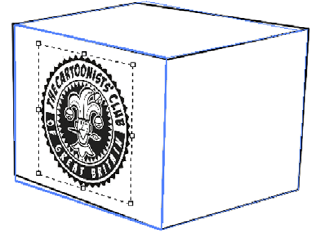
Next, paste your logo that you copied earlier. The blu grids will change to big blu rectangles, and your logo will appear top left of your screen with a selection marquee around it. Press Cmd T (on a Mac) or Ctrl T (on a PC). This invokes the Free transform command which gives little control points at the corners of that marquee. Click on one of those points, hold down Shift and drag to resize your logo. Make it quite small. Then release the Shift key and drag the logo onto your formerly gridded up shape.

When the logo coincides with one of the faces it will be distorted into the correct perspective for that face:

figure.6

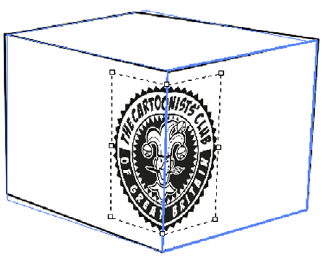
Now try dragging the logo onto another face. As the logo crosses the join between faces, it once more is distorted to match the perspective:

figure.7

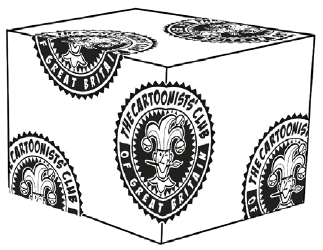
Holding down the Alt key while dragging allows tou to copy the logo as you drag, allowing you to build up a patterned surface:

figure.8

When you’ve finished adding and distorting logos and graphics, click OK and you’ll exit the Vanishing Point mode and return to normal with your distorted artwork now in place.

I’ve cheated a bit in this tutorial… I arranged things so that my original shape actually was in perspective to start with which meant the Parent/Child plane thing worked easily. You may have shapes which don’t have their faces at right angles to each other. You can simply not bother with generating Child planes and simply click and create an entirely separate planes all over your shape. The logo will still distort as before  but it won’t flow around corners. There is a further trick up this filter’s sleeve though. Select the topmost tool in the palette this time. Now when you hover your cursor over a Parent plane’s mid point marker, hold down the Alt key. (Just click a plane first to make it active)

This time the cursor will change to a double ended curved arrow. Then click and drag while keeping the Alt key depressed and the Child plane can be rotated as if it was hinged along the Parent plane. This is dead handy for matching non rectangular shapes.

Here’s a few Top Tips for this Vanishing Point malarkey:

  • If you make a mistake while setting up a plane, hit the Backspace key and your last plane corner point will be deleted.
  • Create and select a new blank layer before you enter Vanishing Point mode. Then any artwork you create in that mode will appear on it’s own separate layer when you click OK and return to normal mode.
  • When you select a Vanishing Point tool, check the little panel near the toolbox and you’ll see a line of info telling you (roughly) what that tool does and how to use it.

More nerdiness next ish!


How it all began! – Alex Matthews

How fellow club members got started in the wonderful world of Cartooning! This article first appeared in The Jester issue 460.

Alexander Matthews cartoonMy training ground in cartooning was the back of the family car. My father used to take us on driving holidays across Europe every year and to occupy my brother Austin and I, my mother used to buy us a stack of comics: Beanos and Busters and Whizzer and Chipses and Nuttys and Dandys and best of all, Oinkses; Summer Specials and Comic Libraries and Annuals and Asterix and Tintin books. Once those were devoured before we’d even reached Dover, we’d get the A4 and the pencils out and draw our own comics, beginning with the front cover topped with a ludicrous name, adorned with allusions to non-existent free gifts and priced imaginatively anywhere between one nanopence and 300 Bazillion Space Groats.

We’d produce literally hundreds of strips, trying to better each others jokes and insane character ideas. Favourite characters I recall include Mantovani’s Minto Farmo, about the conductor who had switched careers to become a mint farmer (not much scope for stories with that one), Pee Ploppy Poo Pah and his Magic Guitar (sophisticated humour it wasn’t), The Incredible Adventures of the Amazing Mr Frosty, an adventurer in a top hat who would begin each strip in an impossible situation set up from a cliff hanger in a non-existent previous episode. There was ‘The Further Adventures of Bingo Gringo’, a mexican bingo loving detective, ‘Pope Gyroscope, the Twirling Ecclesiast’, and millions more.

Pope Gyroscope

Our love of football and comics dovetailed into our magnum opus, a 200 odd episode strip about a football team called ‘Duford Rovers’ (The name was derived from dufus). I still recall the first episode, created by my brother, ‘Manager J. Smith surveyed his team…’ There then followed a picture of each member of the team: There was a player who was dead and was essentially just a coffin, a goalkeeper with no arms and legs, who was eventually superseded by a player who had swallowed and was the same shape as an articulated lorry, a player who had been turned into a dog by a wizard, a player who’s half a body was fused to an office chair. It was sub Billy The Fish stuff, but it had little to do with parodying the odd, cliché ridden world of football and was more an exercise in extreme surrealism. The last line of that first episode was ‘…they played like a dream.’

Robot on the RunWe’d set up a cliff-hanger and it was my or my brother’s task to first extricate the team from the situation before setting up the next cliff hanger. Sadly, big school got in the way after about episode 200 and our minds turned to more grown-up endeavours. In my case, like reading 2000AD. My younger brother didn’t have quite the passion for comics I did and while I aimed towards a career in drawing for a living and just about surviving, he has ended up being well paid for impenetrable financial stuff, is married with two kids and owns a house. Sad, really. A great loss to the world of comics as he was always much funnier than I was.

At about the age of 12 I decided firmly that I would be an illustrator. It wasn’t until 9 years later, having graduated with a degree in illustration, that I decided that being an illustrator was exactly not what I wanted to do with my life. Drawing other people’s ideas in a deliberately annoying and obtuse style simply wasn’t me. So I trained to be a teacher and spent 6 sometimes happy years in schools in London.

Alexander Matthews cartoonOne year, early in my teaching career, I entered the Guardian’s editorial cartoon competition. It was the election with Tony Blair, Michael Howard and Charles Kennedy. My cartoon was published in the Guardian to advertise the competition and I started to wonder whether I couldn’t have a crack at cartooning again. I stumbled across Cartoonstock on the internet and gathered together a few published cartoony illustrations and strips and sent them off. Joel Mishon of Cartoonstock, bless his heart, gave me some very positive feedback but suggested I take a crack at some regular gag cartoons.

Amazingly I’d never really considered gag cartooning and had barely read one. I had this idea that they were just not funny. I immersed myself in them, fell in love and then sat down and produced about 30, which he took. You can still find them on the site. They are the surreal ones that aren’t that funny. Next I set about getting published which took way too many months. My first sale came about due to extreme frustration at the lack of success I was having with Private Eye and the like. I sent a batch off to The Weekly News and they took one in return for a mind-bogglingly pathetic £12.50 cheque. After a year I placed one in Reader’s Digest and then another year later, I sold one to Private Eye. A month later I sold three from the same batch. I figured that if this trend was to continue, I would end up selling more cartoons than there were atoms in the universe every week. Sadly it didn’t, and getting a gag cartoon published is still a struggle! Not for anyone else of course, who manage to get any old rubbish published. There’s a conspiracy against me, you see.

Nuke NoodleAfter a brief 5 year stint as a lecturer in illustration in Moscow, I find myself working full-time in London as a cartoonist, drawing regularly for the Dandy and very soon I’ll have my first Beano strip published. All that writing when I was a child stood me in good stead it seems, as I find that producing a page for a children’s comic is second nature. Sadly the Dandy seems doomed, but I am proud to have contributed the strips ‘Robot on the Run’, Grrrls!, and ‘Nuke Noodle’-my new magnum opus: 59 pages to date of time-travelling wrestler nonsense. Nuke has even managed to rekindle a long-dormant love of kids’ comics in my brother. In the past year the writing has taken over and I am particularly proud of the strip ‘Useleus’, about the world’s worst Greek hero, drawn by the brilliant Wilbur Dawbarn and appearing from time to time in the Phoenix comic. Which reminds me, I must crack on with the next episode…

Alexander’s Cartoon Blog

Alexanders Portfolio

The Jester Potted Interview: Noel Ford

In this series we send members twelve interview questions and they choose a minimum of six to answer.  This interview first appeared in The Jester issue 439

Noel FordHow did you first get into cartooning?

I started out doing a weekly editorial cartoon for the local paper, The Nuneaton Evening Tribune, in the mid sixties, at a pound per cartoon.

What was your first commission?

First I can remember is the most significant. In 1974, working part-time, I sold a speculative cartoon, through my agents at the time, Space Syndications, to the Daily Mail for its Money Mail section. I had never sold anything to the Mail before this but Charles Moore, who was in the process of producing the 1976 Guinness Calendar saw it and invited me to submit some samples, despite the fact that he had pretty much already decided who he was going to commission for the calendar. This pure chance moment resulted in my being offered the commission for the calendar, twelve full colour cartoons at £150 each. On the basis of this commission, in February, 1975, I quit my day job and became a full-time cartoonist. It’s beginning to look like it was a good decision.

How long have you been a member of the Cartoonists’ Club?

I think it must have been around 1972 that I joined the club. Another good decision as it played a huge role in my early development through the opportunity it offered of meeting other cartoonists.

What’s the stupidest question/request you have ever been asked?

(From a corporate client) “Could you include Hitler shooting himself, on our Christmas card?”

Did you ever go to College or University?

Birmingham College of Arts and Crafts, but I left before the end of my foundation year.

Do you belong to any other Clubs or Societies (Cartooning or otherwise)?

Professional Cartoonists’ Organisation, British Cartoonists’ Association, Federation
of Small Businesses, Fellow of the RSA, Making Music (a charitable musicians’
organisation). I’m not sure whether I’m still a member of The Cartoon Arts trust. I did receive a membership card from them which said: LIFE MEMBERSHIP Expires February 2004!

What is the most rewarding job you ever did?

I had my first Punch cover published, just in time for my Dad (from whom I inherited my humour and creative skills) to see before he died.

Have you ever had a client from hell? Tell us more!

I was commissioned to produce some large cartoons for a newspaper ad campaign
by a very big Japanese corporate client. I asked if the characters in the cartoons
should be Japanese or westerners and they said the didn’t have to be Japanese. We went through the roughs stage and I produced the first piece of finished art. The client then cancelled the job because the characters didn’t look Japanese. There was a happy ending,
though. I was paid a cancellation fee of over five thoundand pounds.

What are you working on at the moment?

Illustrations for a book about how to price work for clients. I asked the author if I could read the book before I gave him a price, but he wouldn’t let me.

Do you work with Pen and Ink or are you purely Digital?

I have worked entirely digitally since 1998, starting with a Wacom Serial interfaced A4 tablet and Painter 2.

Where do you get your ideas from?

If I told you that I’d have to kill you.

What is your favourite movie?

I love films but this is impossible question given my eclectic taste. My own collection
includes Alien, Inn of the Sixth Happiness, Amelie, True Lies, A Chorus Line…….

What book are you reading at the moment?

Just finished John Le Carré’s, ‘Our Kind Of Traitor’. Just started Iain Banks’, ‘Surface Detail’.

What do you see yourself doing five years from now?

Cartooning, playing guitar and, hopefully, getting back to writing.

Thanks for your time Noel.
Now get back to work!

Noel’s CCGB Portfolio

Noel’s website


Being a Cartoonist – Dave Follows

Being a Cartoonist – Dave Follows

Featuring archive radio recording of Dave Follows interviewed by Franchesco Williams,
with kind permission of BBC radio Stoke.

A 20-minute archive footage documentary of Dave talking about his cartooning career featuring, how he started cartooning, New York Cartoonists, The Strike, 'May un Mar Lady' and the Creature feature and other life changing events. Divided into eight chapters.

Continue reading Being a Cartoonist – Dave Follows

The Art of Donald McGill – George Orwell

George Orwell
The Art of Donald McGill

Webmaster's note: This essay was written in 1941 and has been posted un-edited. Please do not take offense at some of the phrases/language used.
Click thumbnails to see larger images

''Who does not know the 'comics' of the cheap stationers' windows, the penny or twopenny coloured post cards with their endless succession of fat women in tight bathing-dresses and their crude drawing and unbearable colours, chiefly hedge-sparrow's-egg tint and Post Office red?

Continued…..

Continue reading The Art of Donald McGill – George Orwell