All posts by Vilnis Vesma

How to read Nancy

How To Read Nancy: The Elements of Comics in Three Easy Panels by Paul Karasik and Mark Newgarden. Published by Fantagraphics Books in February 2011. ISBN 978-1606993613 and typically priced around £25

This 80-page paperback qualifies as a coffee-table book (which is how I have illustrated it) not only because of its large format but because it lends itself to dipping in and out. It is about the life and work of Ernie Bushmiller, who enjoyed a long and distinguished career drawing the classic cartoon strip Nancy in the American broadsheet press.

It’s basically a sandwich, opening with a biographical section about the artist and closing with a set of fascinating appendices including among other things numerous illustrations of how a particular comedic graphic idea can recur in different publications drawn by different hands at different times. In this the authors’ meticulous historical research really comes to the fore, and although it isn’t entirely relevant to the life of Bushmiller and the adventures of his creation Nancy, there is a link. The main recurring gag is variations on a slapstick motif: mischievous individuals standing on hosepipes, and the consequent dousing of the user, who witlessly stares down the nozzle just as the flow is restored.

And so to the filling of the sandwich. The central section of the book focuses on just one famous Nancy strip, from 8 August 1959, featuring a hosepipe. This three-panel strip is reproduced no fewer than 44 times on successive double-page spreads with everything removed apart from one particular element that the authors proceed to dissect and explain forensically. It might be one of the props (leaky spigot [‘tap’ for us brits], water gun [pistol], hose etc), or a feature of production design (the house, the fence, the horizon line), or the design of speech balloons, or punctuation; not even the width of the gutters between panels escapes detailed scrutiny and dissection.

I am probably making it sound rather contrived and over-worked, and to an extent it is; it is a highly academic take on the subject. But it is still enjoyable. For one thing the historical perspectives are really interesting; another reason is that you can dip in more or less at random, picking up little insights as you go. This makes the meticulous forensic academic tone more of an amusing quirk than an offputting irritation. So even though I have been drawing cartoons on and off for 60 years—and in recent years even selling them—I still took away numerous lessons about my craft which will help me hone my technique.

Birthday coming up? Ask someone to get this for you as a present.

Droodles

A “droodle” is a simple but cryptic sketch whose meaning you have to guess.

The concept is attributed to the American humorist, author and publisher Roger Price, who published a book of them in 1953. They went on to become not just a popular fad but a syndicated feature in newspapers and magazines, and a television show. I was reminded of them when my daughter presented me with Price’s book, in which his drawings are given their correct description, and a paragraph or two of whimsical narrative. The drawing here is one of my own and it represents A BABY ELEPHANT ON A WHEELBARROW. In Price’s style it might go on to say something like “If you guessed A ROASTED SWAN, you may need to think about your relationship with food”.

Here are a handful more of my own attempts. Click on the image to jump to the official answer combined with shameless self-promotion:

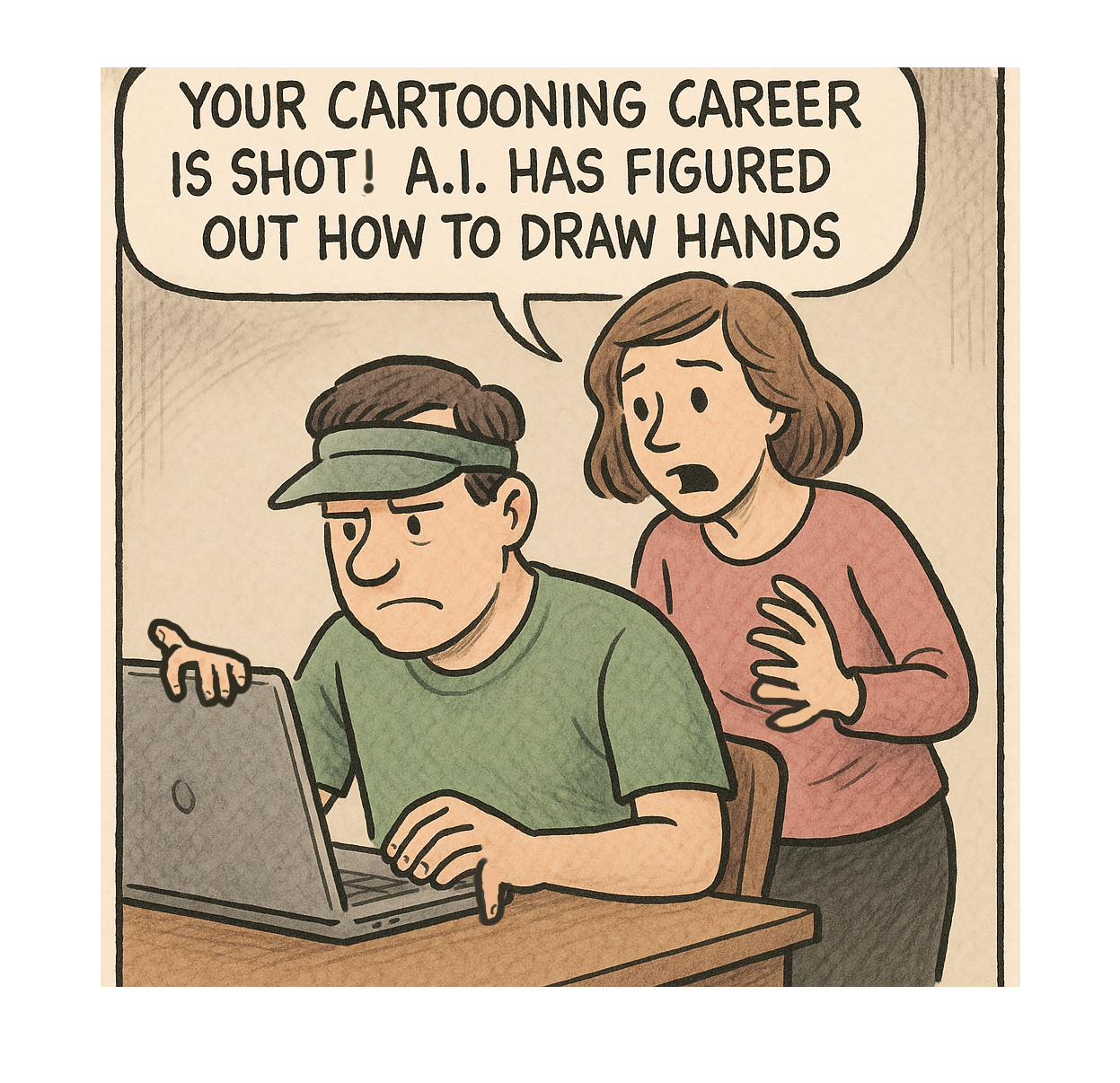
NO A.I. PLEASE

The club’s committee has decided not to approve membership requests from people who claim to be cartoonists but generate their drawings using artificial intelligence.

This follows receipt of a submission from someone whose sample cartoons consisted entirely of digital work that had been “assisted” by AI (his words when challenged). He almost had us fooled until one of us noted the wrong-number-of-fingers symptom. Once we suspected the hand of AI we realised that there were much bigger problems. For example, in drawings of conversations, the speakers’ mouths were closed. In one case two people chatting in a bar were facing away from each other, and the smoke from one character’s cigarette was drifting in the opposite direction to the steam coming off the other person’s glass of whiskey (yes, steam coming off whiskey).

Our guidelines for submissions will be changed to reflect the ban on computer-generated art.

[Postscript: see the position that the club formally adopted]


Censored!

This image has been taken down by Facebook for violating their community guidelines. Their algorithms had decided that it “might contain a depiction of nudity” (images of buttocks being prohibited). Nothing to do with the drawing’s implication that artificial intelligence systems sometimes talk out of their backsides, then.

CCGB member honoured

Pete (right) receives his award from his SE London neighbour Jeremy Banks (‘Banx’)

London-based member Pete Songi has been presented with an award for services to cartooning.

The ‘Splat’ awards are organised by the Professional Cartoonists’ Organisation and were presented in London at their inaugural event, covering 2024, on 16 January. Pete has worked tirelessly to promote gag cartooning by organising well-attended pub exhibitions and launching a digital magazine, The New Cartoonist. Well done Pete

Club Facebook contest

The Club has started a Facebook-based weekly cartoon challenge. Last week’s theme was ‘flying high’ and this is the winning entry, submitted by Ron McGeary.

Each week the winner gets to nominate a theme for the next round, which is announced in a post on the Club’s private Facebook page . Members submit their entries as comments on the announcement post, and from noon each Sunday they can vote for their favourite by giving it a ‘like’. Likes are counted after voting closes on Monday evening at 6 pm.