All posts by Cartoonists Club

Careless Talk

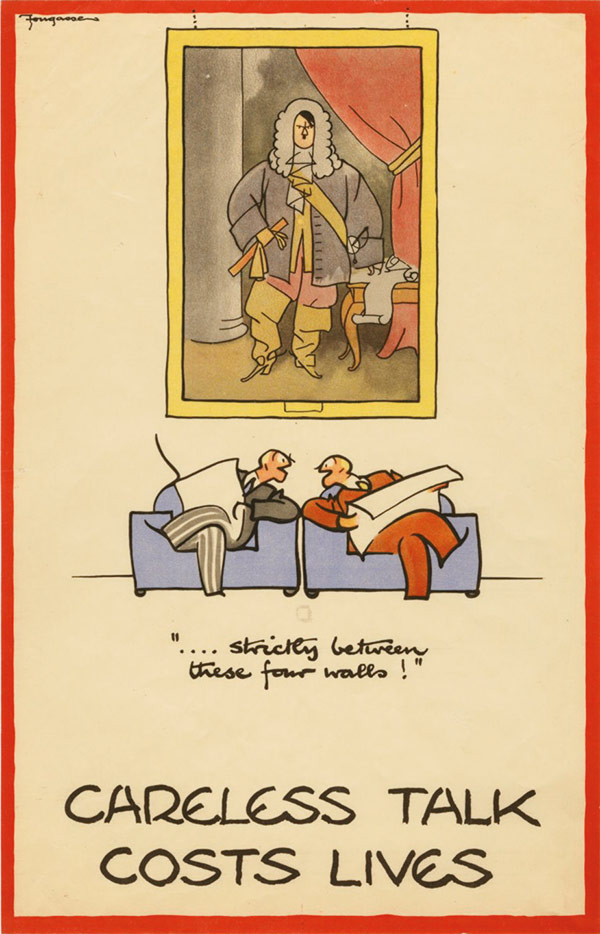
Fougasse - Careless Talk Costs Lives cartoon

By Rupert Besley

There can’t be many cartoonists whose work can be said to have changed the behaviour of a nation. Nor too many whose work affected the course of fashion. And not too many, either (just two), who went on to edit Punch. The cartoonist in question is Cyril Kenneth Bird, known to most as Fougasse.

C K Bird (1887-1965) was an engineer in the army till a shell shattered his spine at Gallipoli and he was invalided out, unable to walk for three years. Taking up his pen, Bird got his first cartoons into Punch from 1916 on wartime themes. The name he adopted was French for an unpredictable explosive device, a small landmine of uncertain aim that might or might not hit the mark. That seemed appropriate for cartoons and for him.

He needed a new name as there was already a Bird in Punch. W. Bird was the pen-name of Jack Butler Yeats, painter, writer and brother of poet and playwright WB Yeats. Jack rose to be ‘the most important Irish painter of the 20th century’, Encycl. Britannica (though my preference would be for Paul Henry any day).

Fougasse cartoon - “to whom, you muddle-headed bird.”
“To whom, you muddle-headed bird.”

He even got to win Ireland’s first Olympic medal through his painting: at the 1924 Olympics in Paris, arts and music were included in the competition at the urging of de Coubertin, keen to recreate the spirit of the original games. Yeats’ Liffey Swim was entered on behalf of the newly created Irish Free State and came home with silver.

But, back in 1916, Yeats was illustrating magazines like Boy’s Own and Comic Cuts, as well as writing for Punch as Bird. Fougasse, meanwhile, went on to become a stalwart of the magazine. By 1937 he was art editor and then actual editor, 1949-53. Most online biographies describe him as the only cartoonist or artist ever to edit Punch. I’m not sure where that leaves Bernard Hollowood (editor, 1957-68), who was also a writer and journalist, but whose first contact with Punch was as cartoonist. His gags appeared in The Times, The Telegraph and The New Yorker, and it is primarily as a cartoonist that Hollowood is remembered.

Style-wise, Fougasse managed to develop in two directions at once. Throughout his career he turned out – as with his Punch covers – artwork that was complicated, busy, detailed, colourful and pictorial.

At the same time, he cultivated for simple gags a distinctive spare style that stood out a mile. In all honesty, it’s not my favourite way with cartoons, a bit too stylised, bare and impersonal for me. But I admire his skill in getting so much across in such an apparently quick and simple way. For catching the eye, delivering a joke or conveying a message, it worked brilliantly. For advertising and for wartime propaganda (to which he offered his services for free) it was perfect.

Which brings us back to where we came in. The Fougasse way with swift line and simplified forms was adopted for Austin Reed adverts. It became the hallmark of good tailoring and even fed back into the new looks that he caricatured.

More literally, his propaganda cartoons were printed on dress material for patriotic women. Best remembered still are the cartoons he did for the Careless Talk Costs Lives campaign.

The extent to which the whole country took the wartime vow of silence is fairly astonishing to us today. Husbands, parted from wives for years on end, exchanged barely a word on the subject afterwards. Secrets were kept for a lifetime. Finlay McKay’s book on Bletchley Park tells movingly how firmly lips were sealed. My great-uncle, home on leave from escort duty with Atlantic convoys, turned angrily on his sister while walking the family’s small, fat dog in the Derbyshire hills. They had paused (as ever, to pick up the dog), when she asked chattily where he was off to next. “Really, Kathleen, you know you mustn’t ask me that,” he snapped, scanning the horizon for listening Nazis dressed as nuns.

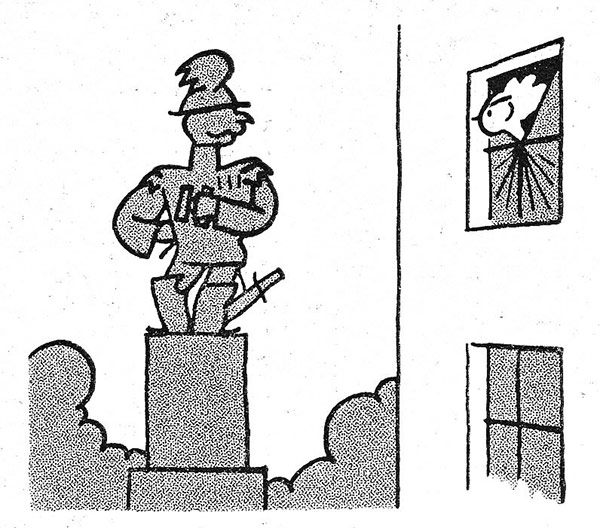
Fougasse cartoonArguably, fear of fifth-columnists got hyped into paranoia. In 1940 a seaside landlady in Sandown was sentenced to death (commuted to prison) for pretending to be retrieving her dog from a prohibited beach while making sketch-maps of gun emplacements and having a secret swastika under her raincoat. Later evidence suggests that Dorothy O’Grady was a sad fantasist seeking excitement and revenge on an unhappy childhood and earlier convictions for pilfering and prostitution. But her maps – and cutting of phone-lines – were deadly accurate.

The Careless Talk campaign was taken to heart by everyone. And thank goodness they did.

This article first appeared in THE JESTER issue 520


Help Make Our Club Even Better and Win!

Win 50 pounds amazon voucher

The Cartoonists’ Club of Great Britain is a club for cartoonists, run by cartoonists. We recognise that being a cartoonist can be a solitary affair, so the club aims to give you an opportunity to get together with like-minded people.

We’re currently taking stock to see if the social events the club offers are those you would like to take part in as a member – and to get your ideas on other events you would like us to organise.

With that in mind we’d appreciate if you could spend 10-15 minutes of your time completing our events survey to make sure your opinions are included. Your responses will only be used to shape the kind of events we offer going forward.

As a thank you, everyone responding to the survey will be entered into a prize draw for the chance to win a £50 Amazon voucher. If we have your  e-mail with your  contact details, you will already have received a personal invite to complete the survey. If we don’t have an email address for you yet, you can access the survey via the members forums.

The survey will close on Wednesday 31 August 2016 so please submit your entry before then to make sure you make the draw. We’ll publish a summary of the survey results in a future edition of The Jester. If you have any questions about the survey please contact events@ccgb.org.uk.

It’s your social club – let’s make it better together.

Thank you for helping,

The Club Committee.

HOW DO YOU DO THAT THEN? – SHADING

How-do-you-do-that-then

RICH SKIPWORTH’S TIPS, TRICKS, AND NERDY TECHNO-BABBLE

One thing that was very popular at the recent Malta Minicon was the “Cartoon Mentoring” session. Some of the lesser experienced cartoonists teamed up with the hard bitten long-in-the tooth professionals for some one-to-one advice on cartooning technique. I paired up with Mitch Mitchell, who was very interested to learn about shading. Mitch was often a bit daunted how to add shading to his cartoons to avoid them looking like just flat pieces of linework. He felt his cartoons would benefit from some shading to make things stand out and make them clearer to read, but he wasn’t sure how to go about it. It struck me that this may well be a common problem with a lot of beginner cartoonists. I remember when I first started cartooning, I would be very reluctant to add shading or colour to my linework in case I messed the whole thing up. So…I thought this might be a useful topic for this month’s “How Do”…

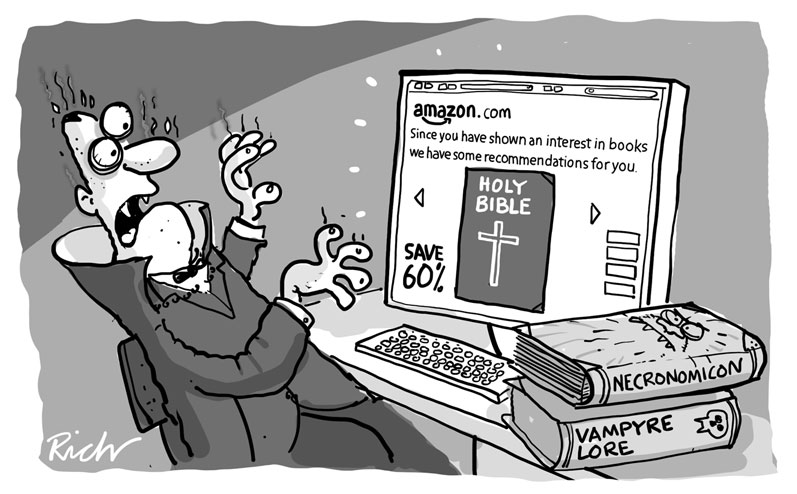
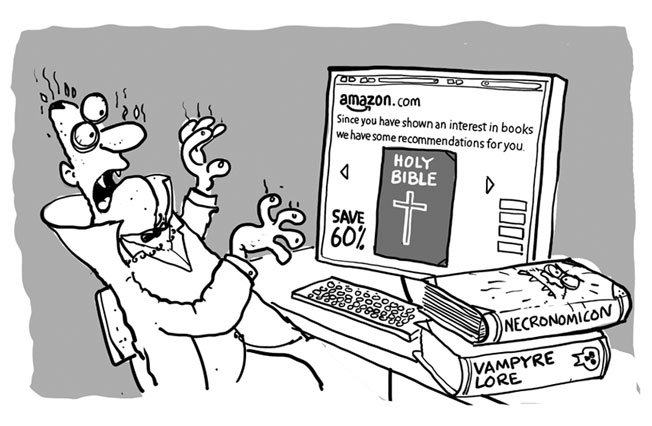
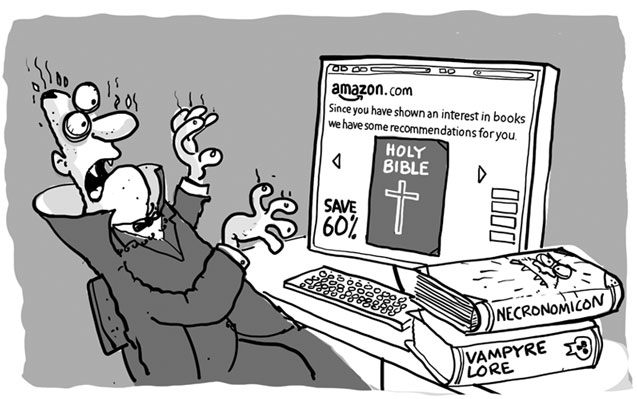
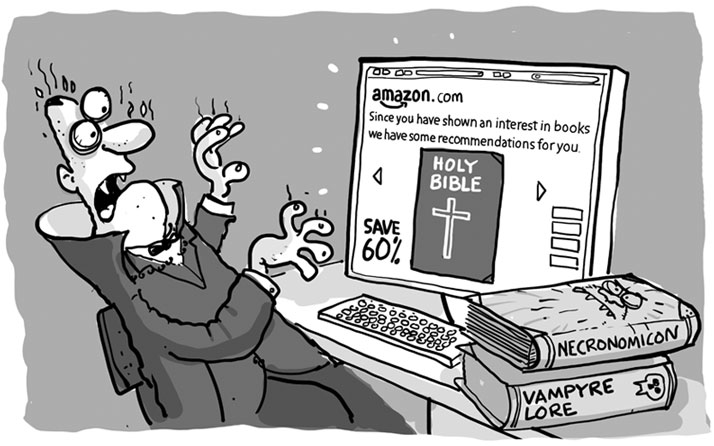
It’s not always necessary to add shading to a cartoon. Plenty of cartoons look great as just simple open black line illustrations. But often they can be improved and given more visual punch with shading applied. Here’s an example: The top pic shows the basic open line version of my cartoon of Dracula browsing Amazon books online. Looks ok, but with some shading added it really stands out on the page..

drac-linework

drac-final

So how do you decide where to put the grey tones, the shading?

First you need to consider what is important in the cartoon, what parts of it really carry the gag. Second, you need to consider where the light source of your cartoon is. In this case, the important bits are the computer screen, and the reaction of Drac to the image on screen. The light source in the picture is easy to work out, it’s the screen. Anything that’s illuminated by the light source will catch the eye and stand out, but make an object appear illuminated, you need to add a contrast between the object and the background. In other words, lighten the bits you want people to notice, darken the rest. You just have to imagine the light hitting your object, and imagine how it might look. Here’s the steps involved in the Drac cartoon shading:

1. With the Drac cartoon, I added a flat grey to the background which immediately threw everything else forward.

drac1

2. Drac wears a dark suit, so the grey of the backgound needed to be lighter than the suit.

drac2

3. Next came some shading to indicate how the light was falling on Drac. Just adding some greys to the parts of the figure away from the light source did the trick.

drac3

4. Next, I dulled down the auxilliary details of the cartoon, which in this case were the books on the desk and the desk itself. They were secondary to the gag, so a bit of grey reduced their prominence, and kept the focus on Drac’s face and the screen. A little extra shading in the form of a dark curve running over the top left of the background gave extra emphasis to Drac’s face by increasing the contrast between his eye area and the background.This also gave a rough impression of the light falling away from the screen towards the left edge of the cartoon, so giving a bit more emphasis on the screen itself.

drac-final

In all these steps I’m constantly trying to get the reader’s eye to be focussed on the important bit: the gag itself Shading of this type is easy when working digitally. For this cartoon, all the shading was done on separate layers in Photoshop, with each layer set to “Multiply” The opacity of all these shading layers could be adjusted to give the best balance between the various tones. Working on paper with pen and ink is a bit trickier of course. I always used to work out the shading positions by overlaying a sheet of tracing paper on the cartoon linework and quickly sketching in the shading with a pencil. Once I was happy I’d got things roughly right I’d use the overlay as a guide and add the tones for real using grey washes of watercolour.

This article first appeared in issue 496 of the Cartoonists’ Club of Great Britain magazine ‘The Jester‘ 

Better ‘Ole Centenary – Part 1

This article first appeared in The Jester issue 492

To celebrate the centenary of Bairnsfather’s original cartoon, this is the first of two articles by Club member Mark Warby looking at some of the many occasions when the “better ‘ole” has been used by other cartoonists, as well as some of Bairnsfather’s own later published versions of it.

Well, if you knows of a better ‘ole, go to it! - Bruce Bairnsfather Bruce Bairnsfather sent his first cartoon to The Bystander in March 1915, while serving as Machine Gun Officer with the 1st Royal Warwickshire Regiment in Belgium. Blown up by a shell during the Second Battle of Ypres in April 1915, he was sent home to England, and while recovering began a regular series of drawings for The Bystander, which continued throughout the war. Compilation volumes of his Fragments from France sold over 1 million copies, and his cartoons were reproduced on all manner of merchandise, from postcards, playing cards and jigsaws to handkerchiefs, and even a range of Bairnsfather  Ware china. His most popular character was Old Bill, a typical old soldier who the men fighting at the front and their families back home took to their hearts. Everyone knew an Old Bill type, and their husbands and sons would write home telling them how life at the front was just as Bairnsfather drew it. Old Bill went on to appear in books, plays and films, and in 1919 Bairnsfather was credited as “the man who made the Empire laugh in its darkest hours.”

Exactly one hundred years ago, on 24 November 1915, The Bystander magazine published what would become Bairnsfather’s  most famous cartoon – and one of the most well-known and enduring cartoons of all time – “Well, if you knows of a better ‘ole, go to it!”

Vivian Carter, Editor of The Bystander, later explained what made “Well if you knows of a better ‘ole go to it” so successful: “Christmas, 1915, marked the lowest level of the Allied fortunes, and angry pessimism was the note of the day. We, the Allied nations, were in an ‘ole, and we knew it, and the question we were all wrangling about, between bombardments, was whether the future was going to show things worse, or possibly better. There was therefore a symbolism about the ‘Better ‘Ole’ picture that raised it altogether above the ordinary ’Fragment’ level.”

The Editor went on to say: “The public saw it and collapsed. It was the limit. A funny picture enough, that of two men engaged in a furious squabble in the midst of a bombardment, but the question of the quarrel – ie, whether by any possible chance either of them could be in a worse predicament – seemed somehow to hit the public in its tenderest spot…no cartoon of the war, in actual fact, hit the public so much as that of the two desperate men in that Johnson ‘ole.”

In comparison to Vivian Carter, Bairnsfather himself “did not think so much of this drawing at the time” and felt it was “no better or worse than the other sketches I had been doing.”

In the one hundred years since Bairnsfather’s drawing was first published in The Bystander, his caption and/or “better ‘ole” theme has been borrowed and adapted by over 130 cartoonists in more than 200 cartoons published in newspapers and magazines in seven countries. At least ten British Prime Ministers, eight US Presidents, four Australian, two Canadian and one New Zealand Prime Ministers have been depicted in that famous setting, along with two Russian Presidents and one King – not forgetting those two progenitors of the First and Second World Wars, Kaiser Wilhelm and Adolf Hitler.

To celebrate the centenary of Bairnsfather’s original cartoon, this is the first of two articles looking at some of the many occasions when the “better ‘ole” has been used by other cartoonists, as well as some of Bairnsfather’s own later published versions of it.

1916 better 'ole - Fred Buchanan The BystanderThe first known occurrence of another cartoonist ‘borrowing’ the “better ‘ole” was on 19 April 1916 when The Bystander published a drawing by another regular contributor, Fred Buchanan, then serving with the Artists Rifles, showing an Attested Man in a shell-hole, telling his companion “Well, if you don’t know of a better ‘ole than this – I’m goin’ to show you one.”

Four months later, on 28 August 1916, it was parodied by Australian cartoonist George Taylor, in the Construction and Local Government Journal, with NSW Premier William Holman and a disgruntled Labour Leagueite in the ‘ole.

For the Christmas 1916 number of Truth, Stranger Pritchard had Ireland as the ‘ole, with Sir Edward Carson and John Redmond debating the Home Rule question.

A football result led to another interpretation. After Stoke beat Liverpool, on 24 February 1917 the Birmingham Sports Argus cartoonist had a pottery jar (representing Stoke) telling a sailor (Liverpool) “If you know of a better ‘ole than Stoke, go to it.”sports argus 24 feb 1917

In 1917-18 Bairnsfather visited the American Army in France, prompting him to revisit the better ‘ole setting, this time with Old Bill and an American soldier ‘Both in the same ‘ole now’ published in The Bystander on 24 July 1918.

I wish I knew a better ole Nuttall 1918 By the end of the war Bairnsfather’s by now famous cartoon had been parodied at least five times. The last occasion was in Melbourne Punch on 18 October 1918, just weeks before the Armistice, when James C Nuttall put the Kaiser in the ‘ole, telling Prince Maximillian of Baden, recently appointed Chancellor of the German Empire, “I wish I knew a better ‘ole.”

The first known version of the better ‘ole by an American cartoonist came in February 1919 when ’Ding’ Darling drew President Wilson telling Congress “if you know a better ‘ole go to it” in a drawing titled ‘The League of Nations argument in a nutshell’ for the Des Moines Register.

On 17 May 1919 New Zealand Observer cartoonist Blo (William Blofield) put NZ Prime Minister William Massey and opposition leader Joseph Ward in the better ‘ole.

A month later Bairnsfather put Old Bill back in the ‘ole, in a special Victory Loan version captioned, ”if you knows of a better loan go to it.” Published in the Daily Express on 28 June 1919, the day the Peace Treaty of Versailles between Germany and the Allied Powers was signed, the original of this new drawing was offered to the highest bidder among readers of the Express.

When the General Strike was called in May 1926, Bairnsfather was living in New York, but responded with a cartoon (recently rediscovered) of Old Bill and Bert as mine workers, published in the Philadelphia Inquirer on 7 May 1926.

A few weeks later, American cartoonist Jesse Cargill had the British Government trying to decide, in the wake of the General Strike, which was the better ‘ole for them. Cargill used the better ‘ole theme in at least nine cartoons between 1924 and 1960.

On 8 July 1927 the St Louis Daily Live Stock Reporter became one of the most obscure newspapers to carry an adaption of the better ‘ole, when their cartoonist William Ferguson drew a farmer in the ‘ole, surrounded by an ‘agricultural battleground.’

On 17 October 1931 David Low (whose work Bairnsfather is known to have admired) used the theme in a cartoon for the Evening Standard. Neville Chamberlain, Max Aitken, Herbert Samuel and others were pictured sheltering in a battlefield crater, with Low giving the report “Battle now raging along entire front, important troop movements may be expected shortly. I distinctly heard Sergeant Beaverbrook tell Field Marshal Samuel that he was ordering all Tariff-Neutrals to be shifted to the Hot Place and if he (Samuel) knew of a better ‘ole, he could go to it.” Low again used the phrase in a cartoon published on 7 October 1933.

better ole Daily Herald 1934 - Bruce Bairnsfather From 1933-34 Bairnsfather contributed over 200 cartoons to the Daily Herald, which then had the largest circulation of any newspaper in the UK. Many of his later drawings for the paper had a sporting theme, and on 2 March 1934 the Herald published a cartoon of Old Bill and Bert atop a roof overlooking Wembley football ground, with a telescope to watch the Arsenal-Aston Villa cup tie, Old Bill telling Bert: ”If you knows of a better seat, go to it.”

From 1934 Bairnsfather actively supported the British Legion. He appeared at branches around the country, giving talks to help raise funds and boost membership. He also contributed a monthly cartoon series ‘The New Fragments’ to the British Legion Journal, and in October 1935 Number 17 in the series showed Old Bill and Bert in an updated version of the better ‘ole.

In August 1937 Toronto Daily Star cartoonist Les Callan drew Old Bill sat atop the Shanghai International Settlement as it was being bombarded during the Sino-Japanese War. The caption was “No better ‘ole, Bill?”

During a speech in Blackburn on 22 February 1939, Prime Minister Neville Chamberlain responded to critics of proposals to abandon steel shelters for deep shelters, by borrowing BB’s famous phrase, commenting “No doubt it would be comforting to think that in an air raid we could all get into a better ‘ole where we should be perfectly safe.” Two days later, Daily Express cartoonist Strube put the Prime Minister (‘Old Nev’) in the ‘ole with his ‘Little Man’, who he was telling “Better ‘ole? This is the better ‘ole.”

With war clouds looming ever closer, Strube’s cartoon was the last occasion the “better ‘ole” was used in a peace-time setting for six years.better ole - Strube - Daily Express 1939

In Part Two of this feature I’ll be looking at some of the many other “better ‘ole” cartoons from the Second World War through to the present day.

www.brucebairnsfather.org.uk

John Burningham’s Champagne

John Burningham’s Champagne

The Chris Beetles Gallery.

8 & 10 Ryder Street, St James’s, London SW1Y 6QB.

28 October – 14 November, 2015. 10am – 5.30pm

An exhibition of new work by cartoonist and illustrator, John Burningham, is being held at the Chris Beetles Gallery to coincide with the launch of a new book entitled “John Burningham’s Champagne”.

BorBurnhamn in 1936, John attended the Central School of Art in London in 1956, where he created models and puppets for a film company in Israel until his return to England in the autumn of 1960. It was at this point that his life as an illustrator began, creating posters for London Transport, drawing cartoons for magazines and designing Christmas cards. He published his first book in 1963.

As well as changing the face of children’s books with his witty, poignant and exquisitely drawn stories: Borka, The Adventures of a Goose With No Feathers, Mr Gumpy’s Outing, Granpa, Courtneyand Avocado Baby, to name but a few. John has also produced a series of highly distinctive books for adult readers. After John Burningham’s England (1992) and John Burningham’s France(1998) comes John Burningham’s Champagne, a book that is as original, charming and beautiful as any he’s ever created. And, like its predecessors, it is born of personal experience and infectious enthusiasm.

The exhibition is accompanied by a delightful 184-page book featuring 50 new illustrations and many wonderful quotations, photographs and other images spanning 300 years of this scintillating wine. Foreword by Joanna Lumley.

CCGB returns to the Lakes International Comic Art Festival

Lakes International Comic Art Festival 2015Those of you who went along to the excellent Lakes International Comic Art Festival in Kendal last year will have no hesitation in joining us there again this year for an absolutely packed weekend away. (16-18 OCTOBER, 2015 )

All weekend the Club will have a table in The Comic Clock Tower 
selling members merchandise and promoting the club. So if you have any books, comics, cards etc. that you’d like to sell please get in touch with us straight away.

We are also giving a talk about the CCGB in its 55th year on Sunday 18th October –“What’s in it for You? The Cartoonists’ Club of Great Britain”
And if that wasn’t enough we’ll also be holding our 2015 AGM at the festival as we did last year in the magnificent town hall council chambers.

So if you’re a club member come along and join in with a fantastic weekend. And if you’re a cartoonist who isn’t a member yet then drop by and say hello to find out what you’re missing.

You can find out much more about the festival at:
www.comicartfestival.com

Read about our visit to the festival in 2014 >

comics clock tower